Portable Power Station for Camping: LiFePO4 vs NMC Guide
Compare LiFePO4 and NMC camping power stations by cell evidence, energy budget, inverter limits, cold charging and solar-input compatibility.
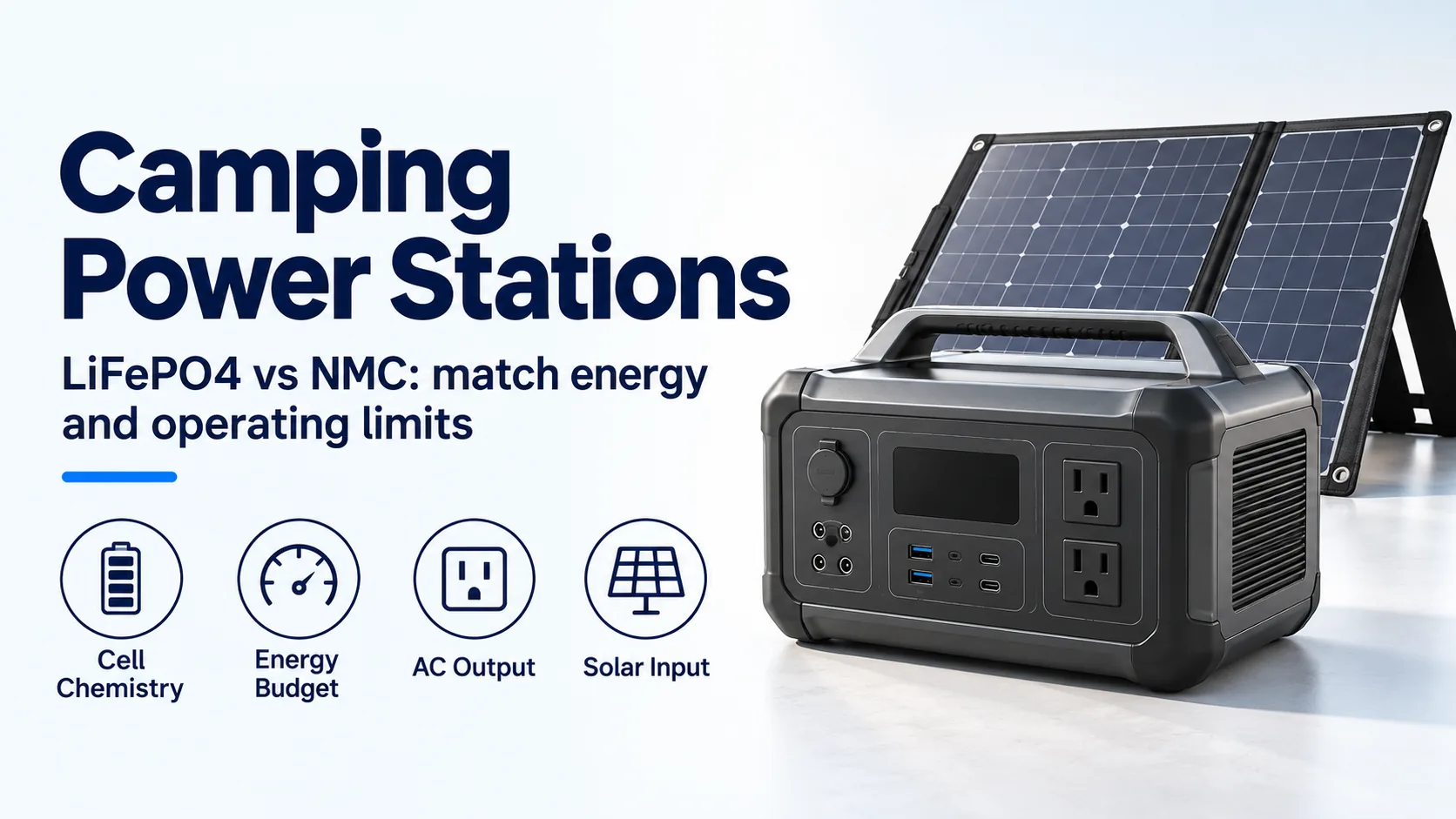
A portable power station for camping can have the preferred LiFePO4 or NMC chemistry and still leave the campsite without usable power. Choose between LiFePO4 and NMC by checking the battery evidence, then the energy needed, the output your equipment accepts, and the conditions under which the station can recharge.
For a portable power station for camping, favor documented LiFePO4 cycle durability when frequent reuse matters, but compare complete stations before choosing a chemistry. NMC needs the same checks for charging temperature, protection and usable output. A chemistry name does not specify the inverter, solar controller, port allocation or energy delivered to your equipment. Start with the required connections and energy budget, then use the battery documentation to decide between candidates that can actually do the job.
The Charging & Power Guides collect the related decisions. If the trip only needs USB charging, first use the power-bank capacity and protocol guide to check whether a smaller kit covers it.
Scroll horizontally to see all columns.
| Input or item | Typical value or source | Why it matters |
|---|---|---|
| Battery chemistry | Cell and station maker’s documentation | Identifies which cycle and temperature evidence applies |
| Required trip energy | Your equipment’s documented draw and intended operating time | Determines the energy budget before choosing a station |
| Stored energy and output | Watt-hours and continuous watts on the exact station | These answer duration and load compatibility separately |
| Charging conditions | Station manual, including battery temperature restrictions | Cold operation and cold charging can have different limits |
| AC waveform | Explicit inverter specification | A large output number alone does not describe the waveform |
| Solar input | Controller voltage, current, power and connector requirements | Panel wattage alone cannot establish compatibility |
LiFePO4 versus NMC: compare evidence at the right level
LiFePO4, also called LFP, and nickel manganese cobalt (NMC) are lithium-ion battery chemistries. LFP has a documented durability and thermal-stability argument, but it is a starting point for comparing stations. Lithium Werks’ chemistry note, checked 19 October 2026, says LFP typically offers longer cycle life than NMC and describes NMC as more susceptible to thermal runaway at lower temperatures, especially when fully charged. The note supplies no universal NMC cycle count or failure temperature.
Use that distinction to decide which documentation deserves closer attention. For frequent camping, ask how the station maker defines a cycle and the remaining-capacity endpoint. For a kit carried on foot, compare the complete unit’s published carrying mass, dimensions and connections. Do not replace those measurements with a presumed weight advantage from the chemistry name. Enclosure, cooling and inverter hardware also belong in the bag.
A cycle claim needs its operating conditions. The Lithium Werks energy-cell page, checked 19 October 2026, lists more than 2,000 cycles at 0.5C charge and discharge with 100% depth of discharge, in specifications referenced to 23°C unless otherwise stated. It does not print a remaining-capacity endpoint alongside that row. This is evidence for that cell, not a lifetime promise for an unnamed camping station.
Scroll horizontally to see all columns.
| Candidate | What to compare | Dominant failure mode & prevention |
|---|---|---|
| LiFePO4 station | Pack cycle conditions, charging limits, carrying mass and output | Battery damage from charging outside the documented temperature envelope; follow the station manual’s charging arrangement to bring the battery within range before charging. The cited Lithium Werks limits and cycle evidence apply to its cell, not a whole-station warranty |
| NMC station | The same pack, temperature, output and portability records | Battery damage from charging outside the candidate’s documented temperature envelope; charge only within its own manual’s limits using its documented charging arrangement, without borrowing the LFP cell’s limits |
| Either chemistry | The exact ports and input modes you will use | Equipment fails to start or run when the inverter cannot support its load or required waveform; match continuous output, startup requirements and waveform to the station and equipment documentation before choosing the inverter |
This table deliberately keeps the selection at the system level. A station is useful only if its battery, controller and output stage support the same trip. A promising cell cannot compensate for an unusable charging input.
Cold charging needs its own temperature check
A battery’s discharge range does not authorize charging across that range. In the same Lithium Werks cell specifications checked 19 October 2026, charging is listed at 0–60°C, while discharging is listed at −20–60°C. Those are distinct limits for the named cell.
Threshold rule: If battery temperature is below 0°C while charging a system using that documented cell envelope, choose a charging arrangement that brings the battery within its permitted range before charging, because the cell maker’s charging range starts at 0°C. For a finished station, follow its own manual and any documented heater or low-temperature protection instructions.
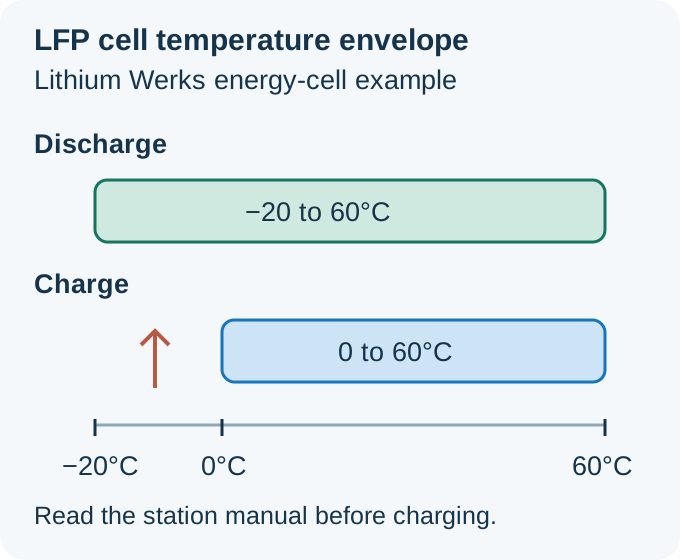
The cell maker’s ranges illustrate why discharge permission cannot be reused as charging permission; the station manual determines its operating envelope.
Plan the charging location before leaving. An overnight campsite, a parked vehicle and the place where a panel sits can expose the equipment to different conditions. Check the manual’s temperature guidance, keep ventilation clear and follow its moisture restrictions. A protected location is useful only when it also meets those instructions; covering an operating station can obstruct cooling.
The NMC candidate needs an equally explicit temperature record. The chemistry comparison does not supply that record. If the seller cannot identify an applicable manual, leave the candidate unconfirmed rather than assuming another station’s limits apply.
Divide watt-hours by draw for an energy example
Duration depends on energy delivered at the chosen output and the load’s average draw. Use matching measurement boundaries:
Ideal duration (hours) = stored energy (Wh) ÷ constant load (W)
Output duration (hours) = usable energy at that output (Wh) ÷ average load (W)
Labeled energy example, not an appliance runtime: EcoFlow’s RIVER series comparison, checked 19 October 2026, lists 512 Wh stored energy and 500 W total AC output for the US/Canada RIVER 2 Max. Assuming a constant 500 W load solely for this calculation, 512 Wh ÷ 500 W = 1.024 hours before conversion losses, reserve and operating cutoffs. The draw is an example assumption using the printed output ceiling, not a claim about camping equipment.
For an actual trip, record the equipment and its intended operating time. Keep continuously operating equipment separate from items used briefly. Where a load cycles, an instantaneous running figure is not its trip average. Use the equipment maker’s consumption information or a suitable recorded energy measurement for the intended duty; leave unknowns visible until resolved.
Stored watt-hours alone cannot establish usable AC watt-hours. The inverter and other operating electronics draw from the same energy supply. Do not apply an invented efficiency percentage to turn the label into a guaranteed runtime. If a maker provides an output-energy result, retain its stated load and conditions when comparing it with another candidate.
Inverter output and waveform are separate requirements
Match continuous output and waveform to the equipment manual before considering a station’s surge or boost headline. A startup allowance is a different claim from the output the station can sustain. Record both without treating them as interchangeable.
EcoFlow’s comparison, checked 19 October 2026, explicitly describes the RIVER 2 Max AC outlets as pure sine wave. That is a documented example of a waveform specification. It does not establish that every portable station has the same output, or that every appliance will start from it.
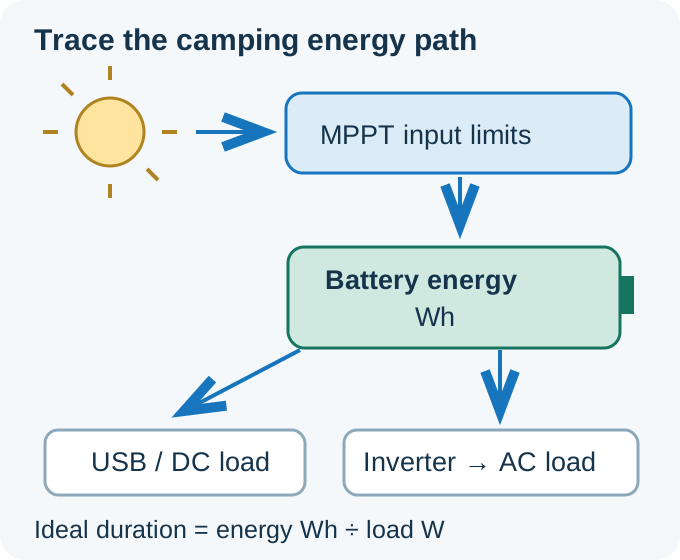
The input controller, stored energy and output paths answer different compatibility questions. The arrows show connections, not measured efficiency.
Trace the connection you intend to use. A USB-powered device may have a compatible direct output available; AC-powered equipment instead depends on the inverter and its requirements. Compare the documented paths rather than assuming the presence of an AC socket settles the choice. The device’s protocol and connector still matter on a direct USB connection.
MPPT does not remove solar-input limits
MPPT is a controller function, not a promise of a full recharge at camp. EcoFlow’s series comparison describes its MPPT controller as monitoring voltage and current. Weather, shading, placement and the permitted input envelope remain separate planning questions.
Read the panel and station documentation together. Check the controller’s voltage range against the panel’s applicable open-circuit voltage information, including its cold-weather guidance. Then check current, power, connector and polarity requirements. Do not infer electrical compatibility from plugs that happen to fit, or propose a series or parallel arrangement without the relevant instructions.
Keep a fallback charging plan if the trip depends on powered equipment. An energy budget that assumes a solar refill needs a supported yield estimate for that campsite and season. Without one, treat solar as a possible replenishment source and plan the required stored energy accordingly. The camping energy, weight and solar checklist helps keep the panel, placement and carried kit in the same decision.
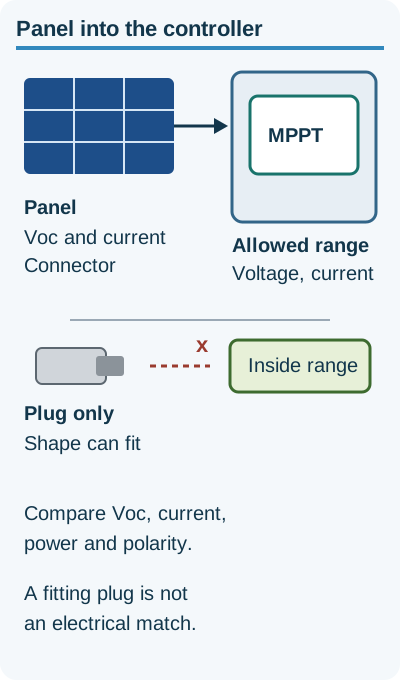
A cell cycle or temperature row does not warranty the finished station.
Hidden costs belong in the complete camping kit
The relevant cost is the usable kit, including documented cables, adapters, charging equipment and the effort needed to carry and set it up. An attractive station can become awkward if its required solar lead is absent, its connector needs another approved part or its charging location conflicts with the campsite layout. The camping energy, weight and solar checklist is the inventory for that panel, lead and carried kit.
Before buying, write down what comes in the box and what the intended connections still require. Record whether mains charging is built in or requires an external supply. Check whether a panel is included and compatible instead of reading a product photo as a packing list. These checks expose additional purchases without inventing a price comparison.
Also account for time. A kit that requires equipment to charge sequentially changes the schedule even when its total stored energy is sufficient. A return trip to an outlet is a planning cost. Compare the actual port combination and charging instructions so that the least convenient part of the setup is visible before departure.
Choose the station that satisfies that complete record: equipment connection, usable-energy evidence, operating temperatures, carrying requirements and replenishment plan. Then use the LiFePO4 or NMC evidence to resolve the remaining tradeoff. Chemistry is valuable information when it is attached to a station that already fits the trip.
Sources
Updated 19 October 2026. Method: compare published cell specifications and OEM power-path descriptions, then distinguish those claims from dimensional energy calculations and trip-planning assumptions. The numeric example is an ideal energy division, with no measured runtime or invented loss factor.
Related articles
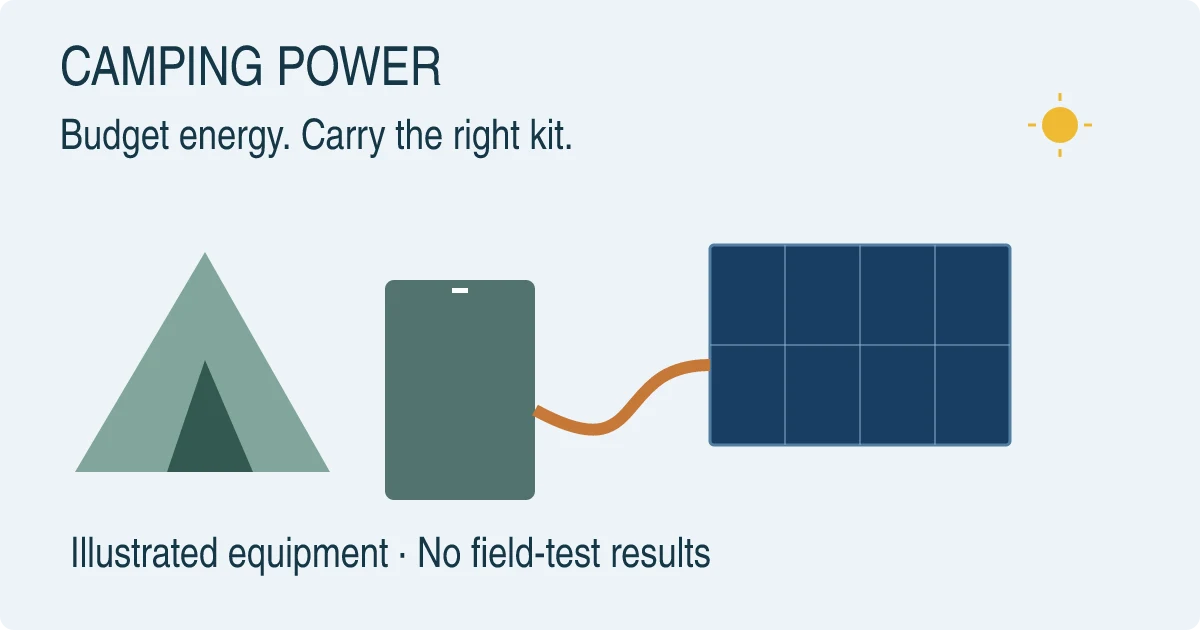
Camping Power Banks: Capacity, Weight and Solar
Size a camping power bank from measured USB energy, full-kit weight, and the sunlight a panel can collect. A 60W or 240W mark is a cable logo.
Read article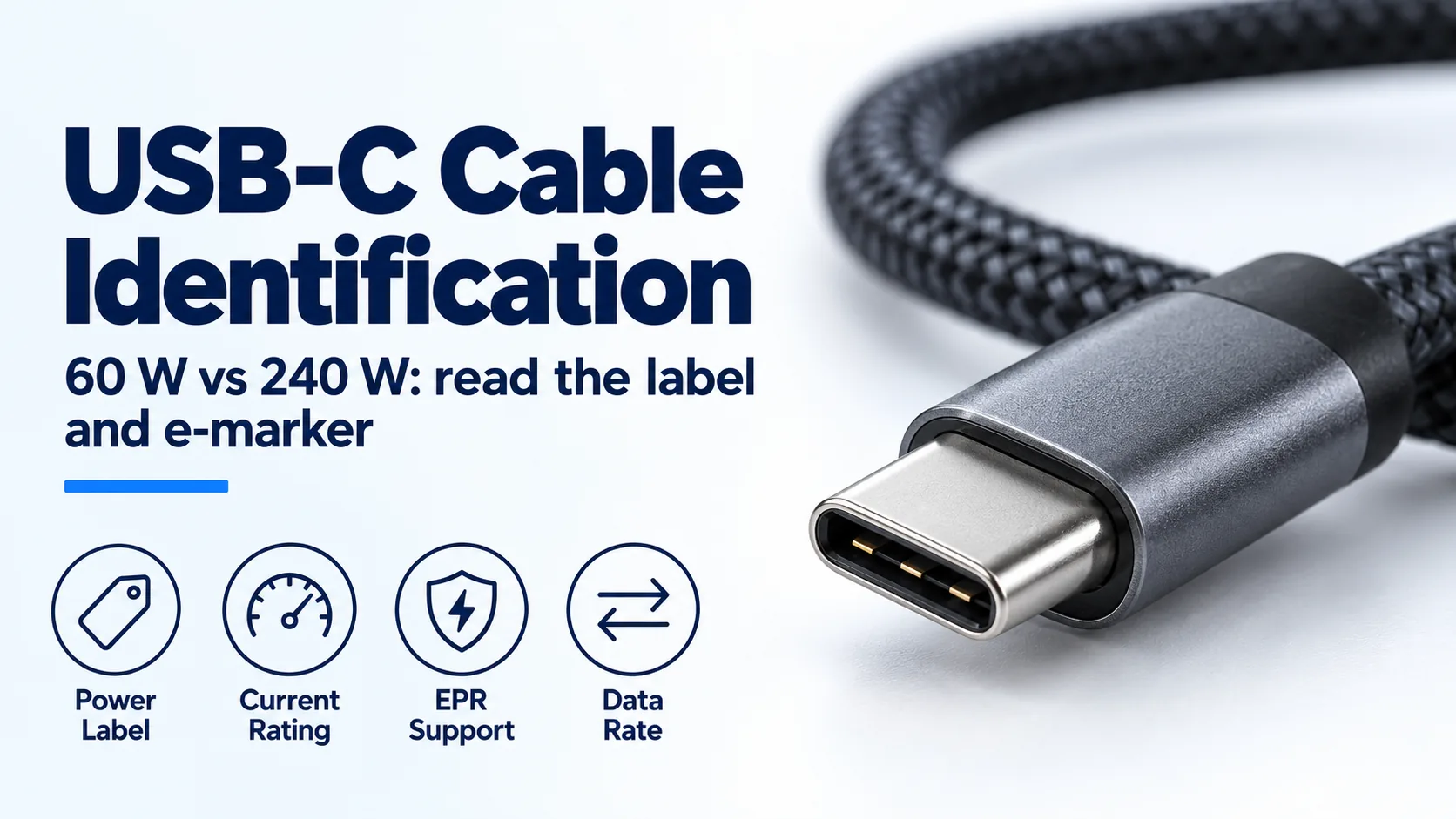
USB-C Charger Cable: 60W vs 240W E-Marker Identification
Identify a USB-C charger's cable by its 60 W or 240 W label, current capability and e-marker; distinguish older 100 W cables from EPR.
Read article
Do power banks go bad if not used?
Storage after disuse: Anker's 3-4 month recharge and 20-36 month drain window, with every unprinted percent, cycle life, and watt-hour left blank.
Read article