Surge Protector vs Power Strip: Joules
A surge protector clamps a short spike, usually with a MOV. A power strip only adds outlets. An overload or thermal breaker is not surge protection.
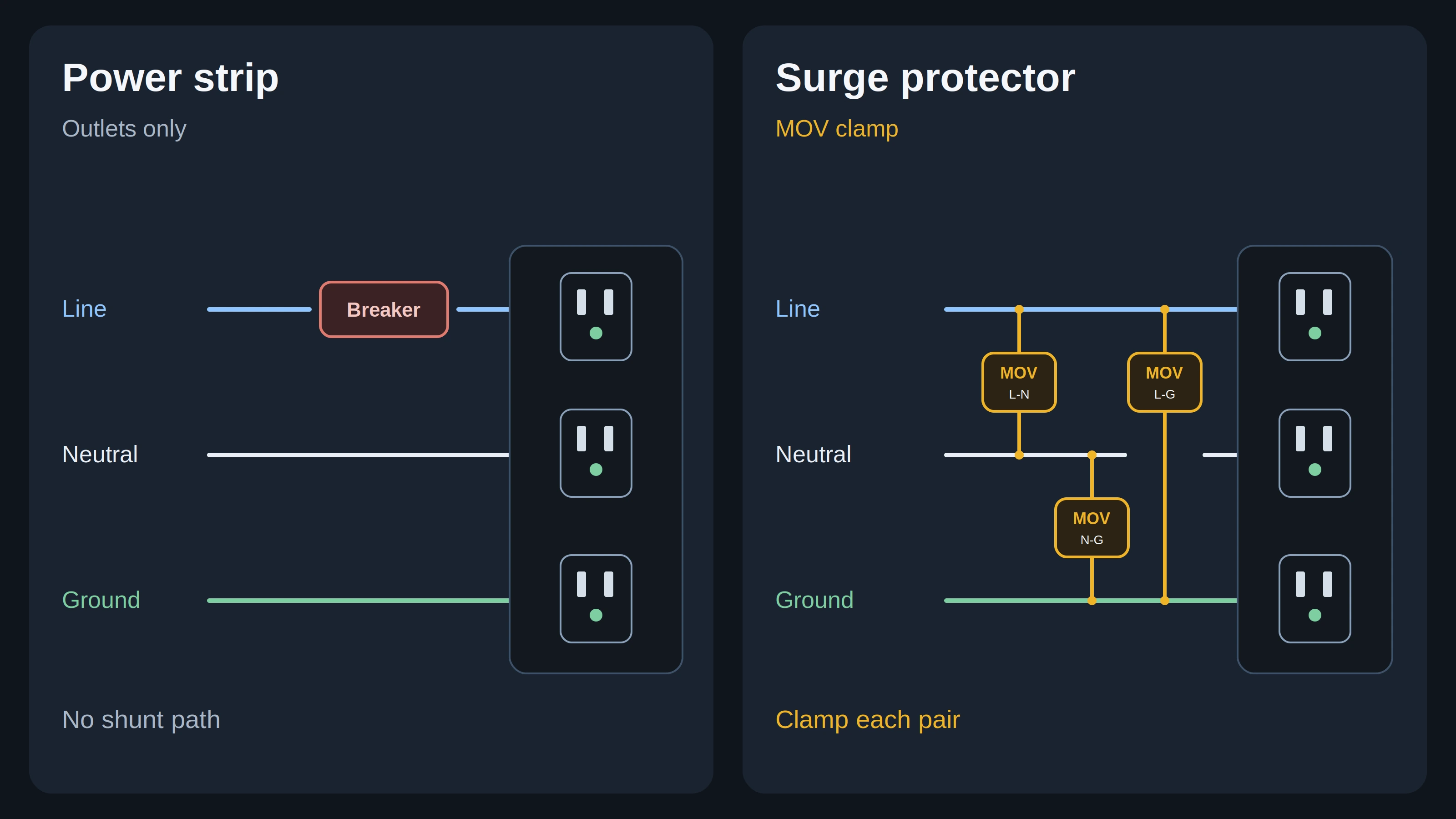
A surge protector clamps a short voltage spike, usually with a metal-oxide varistor (MOV). A power strip only adds outlets. An overload or thermal breaker is not surge protection.
A surge protector, also called a surge protection device, is built for voltage spikes that last microseconds. It limits the voltage supplied to the plugged-in equipment by short-circuiting current to ground or by absorbing the spike. In the shorting method the conductors are clamped to a target voltage, as by a MOV, and that spike lasts only tens of microseconds. The energy leaves in the wiring, the ground, or the protector, as heat.
A power strip is a block of sockets on the end of a flexible cable, with a mains plug on the other end. The UL Solutions guide states the same split: the strip is an extension cord with extra outlets, and the surge protector adds the clamp that pulls the surge off the computer, the television, or the stereo downstream.
The charging and power guides cover the charger, the cable, and the phone. This page covers the outlet bar those adapters plug into.
How do you tell a power strip from a surge protector?
Many power strips have basic surge protection built in and are typically labeled as such. In countries without regulations, Wikipedia records power strips labeled as surge or spike protectors that contain only a capacitor, an RFI circuit, or nothing that suppresses a surge. ESFI’s indoor booklet says not every power strip is a surge suppressor, and not every suppressor is built for the same load.
Surge suppression is usually one or more MOVs. A low-cost strip often has a single MOV between the live conductor and the neutral. A more complete strip fits one MOV across each pair. Household receptacles use line, neutral, and ground, and many protectors bond those conductors in pairs: line-neutral, line-ground, and neutral-ground. NEMA also lists line-to-line among the modes on a multi-mode device.
A neon lamp or an LED that only shows power is on is a power light. It is not the lamp that reports the protection parts. Better-quality surge-protected strips add lights for those parts, and those lights are not always reliable. On some strips the red lighted rocker is the handle of a thermal circuit breaker. A trip flips it off. Flipping it back on resets it. The primary job of the surge protection device is still to divert a short voltage spike to ground.
NEMA names ANSI/UL 1449 as the listing standard for surge protective devices. A listed device has met that standard. A component-recognized device may not have been run through every requirement, and the maker has to be asked for the conditions of acceptability. The UL Solutions guide treats a UL certification mark as the sign that fire, shock, and personal-injury hazards were examined.
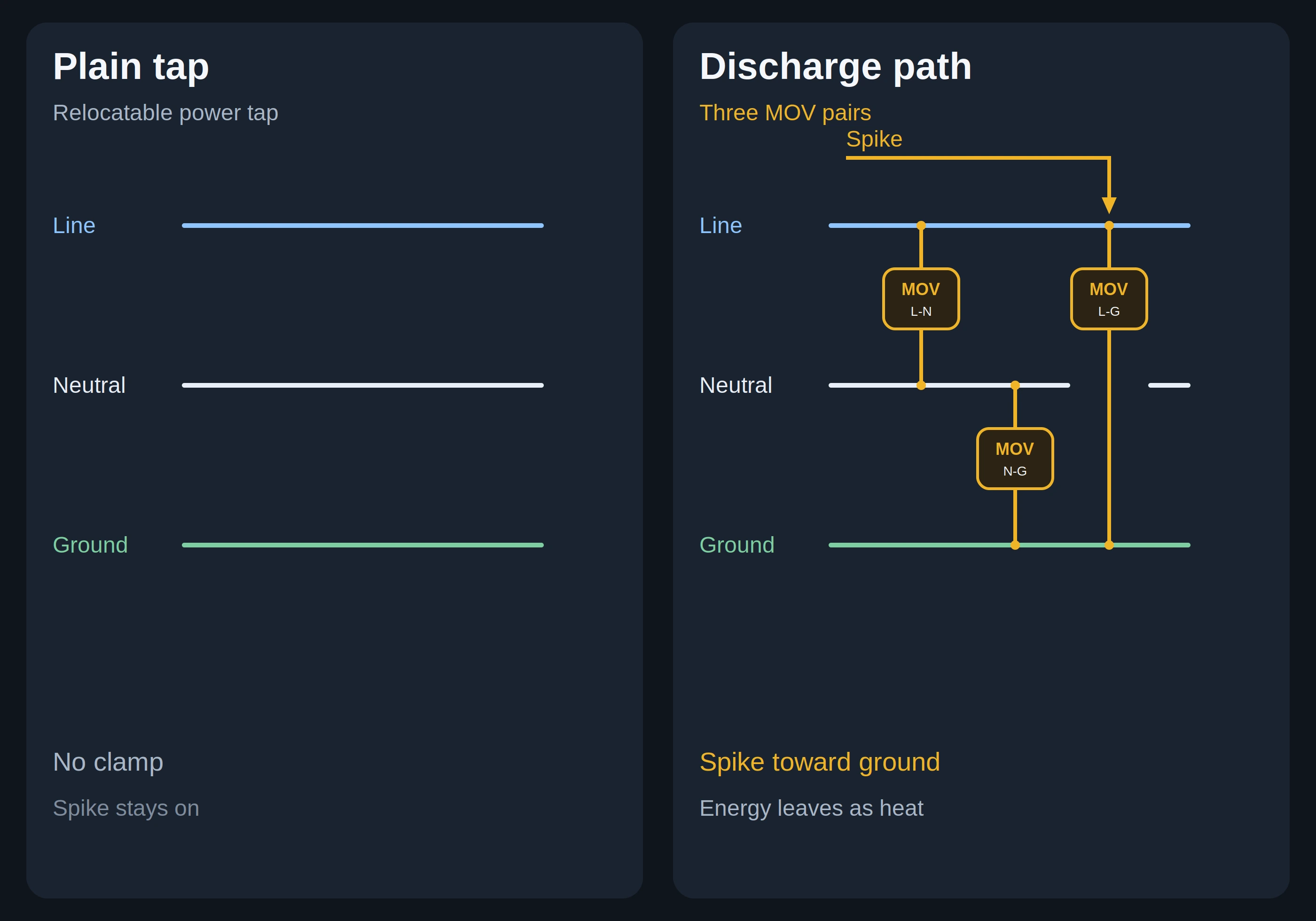
A relocatable power tap carries line, neutral, and ground straight through. A varistor routes a short spike from the line toward ground.
Which marks replace a joule comparison?
Read type, voltage protection rating (VPR), maximum continuous operating voltage (MCOV), and nominal discharge current, written In. NEMA says UL and IEEE do not recommend comparing joule ratings. There is no clear standard for measuring that energy, and the figure is easy to manipulate. Compare In and VPR only for the same type and the same voltage.
Type 3 is a point-of-utilization device. NEMA places it at least 10 meters (30 feet) of conductor from the service panel, and that length does not include the leads supplied with the device. NEMA’s examples are a cord-connected strip, a direct plug-in, and a receptacle device. Type 5 is a discrete component, such as a MOV on a board. It is not itself a listed strip.
VPR replaced the older suppressed voltage rating. NEMA derives VPR from a 6 kV, 3 kA combination wave, and the marked value is the rounded-up average taken from a table that includes 330, 400, 500, 600, and 700. A suppressed voltage rating from the 2nd edition and a VPR from the 3rd edition are not comparable. The later test uses six times higher current and energy. The UL Solutions guide still describes a suppressed voltage rating and treats a lower number as better protection. That sentence is the older rating. It is not the current VPR table, and the guide’s upper end of that older range is not a VPR.
Wikipedia calls clamping voltage the spike level that makes the protective parts short or clamp. It names 330 V, 400 V, and 500 V as the lowest three UL levels, and it calls 330 V the standard let-through for 120 VAC equipment. The same page says a lower clamping voltage indicates better protection and can sometimes shorten the life expectancy of the protective system. Those sentences are Wikipedia’s.
A 1989 NIST preface, reprinted from the Zurich symposium, calls the early belief that lower clamping is better a misconception. The preface says the 330 V row of the IEC table was meant for circuits up to 50 V, not the 120 V of consumer electronics. The 330 V step stays on the NEMA table. The NIST sentence locates the IEC row. It does not remove the NEMA step.
MCOV is the highest continuous voltage the device withstands before conduction begins. NEMA says it is typically 15 to 25 percent above the nominal system voltage. In is the peak of an 8/20 current wave after which the device still functions for 15 surges. The marked levels include 3 kA, 5 kA, 10 kA, and 20 kA.
Wikipedia defines the joule rating as the energy a MOV-based protector can absorb in one event without failure. Paralleled MOVs do not add that capacity as a clean sum, because the parts do not share current evenly. A derate of 20 percent or more is usually required. Shop with In and VPR.
Response time is not a useful comparison among MOV protectors. The parts respond in nanoseconds, and the test waves are measured in microseconds.
The label also shows a short-circuit current rating. NEMA defines that rating as the fault current the device is suitable for on the AC circuit. It is not the surge current.
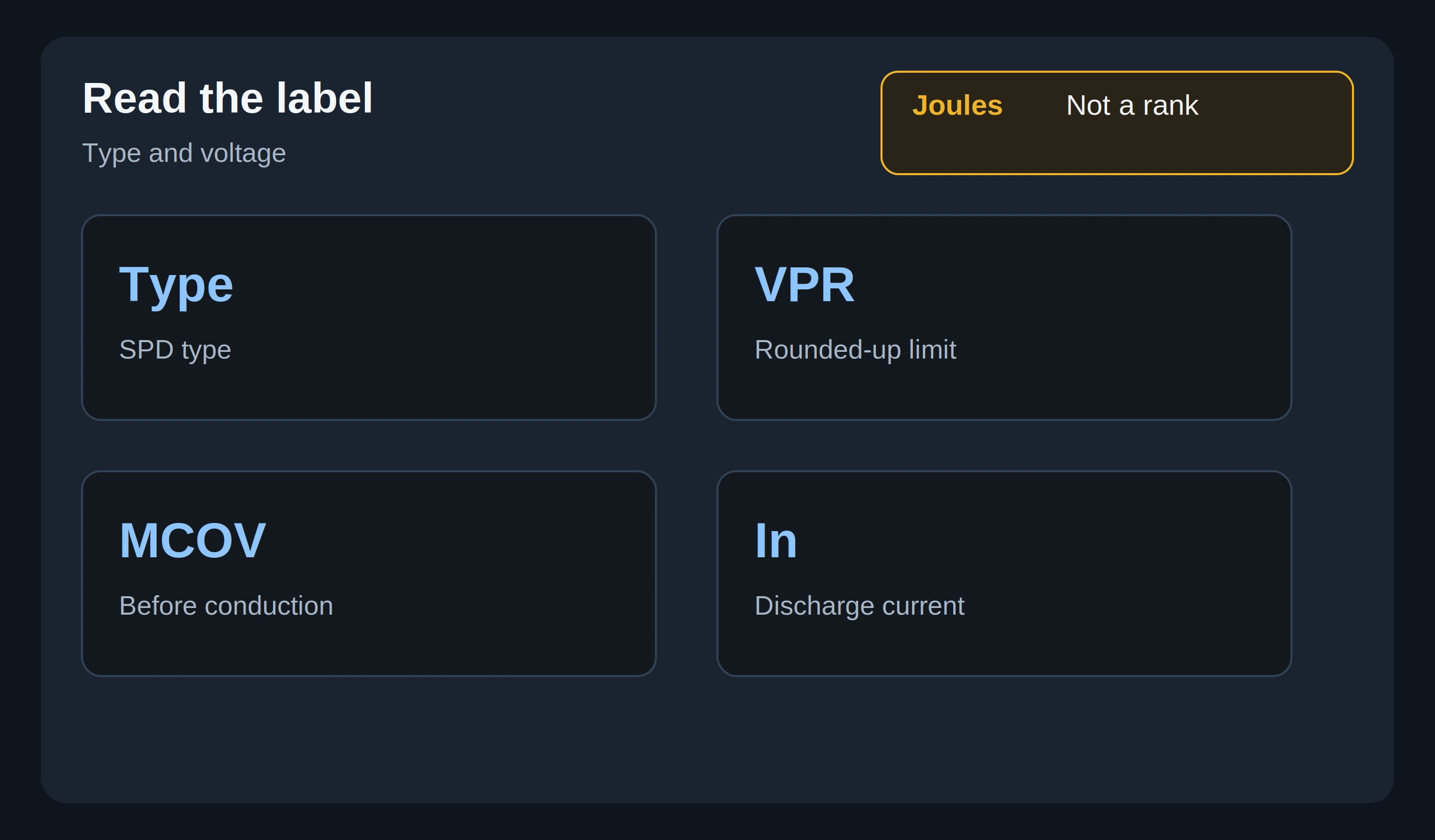
Compare voltage protection rating and nominal discharge current for the same type and the same voltage. Joules are an energy figure, not the ranking NEMA uses.
Scroll horizontally to see all columns.
| What you are reading | Power strip | Surge protector |
|---|---|---|
| What the hardware adds | More outlets on one cord | More outlets, plus a clamp |
| Lighted overload rocker | Opens when the load is too high | Opens when the load is too high |
| Part that meets a short spike | None, unless the strip is also a surge device | A MOV or another clamp |
| Marks that decide the choice | The listing and the ampere rating | Type, VPR, MCOV, and In |
Which loads stay off the strip?
Portable electric heaters are high-wattage appliances. CPSC Publication 098 says never power the heater with an extension cord or a power strip. Keep combustible material at least 3 feet (0.9 m) from the front, sides, and rear of the heater.
ESFI’s indoor booklet says to plug a portable space heater directly into an outlet and not to use an extension cord. That ESFI sentence does not name a power strip. The same booklet says a heating element can demand a lot of power. Use the CPSC sentence when the question is a power strip. Use the ESFI sentence when the question is an extension cord.
OSHA’s November 18, 2002 letter says strips are designed for low-powered loads such as computers, peripherals, and audio or video equipment. They are not designed for space heaters, refrigerators, and microwave ovens. Section 1910.304 says an outlet device needs an ampere rating at least equal to the load it serves.
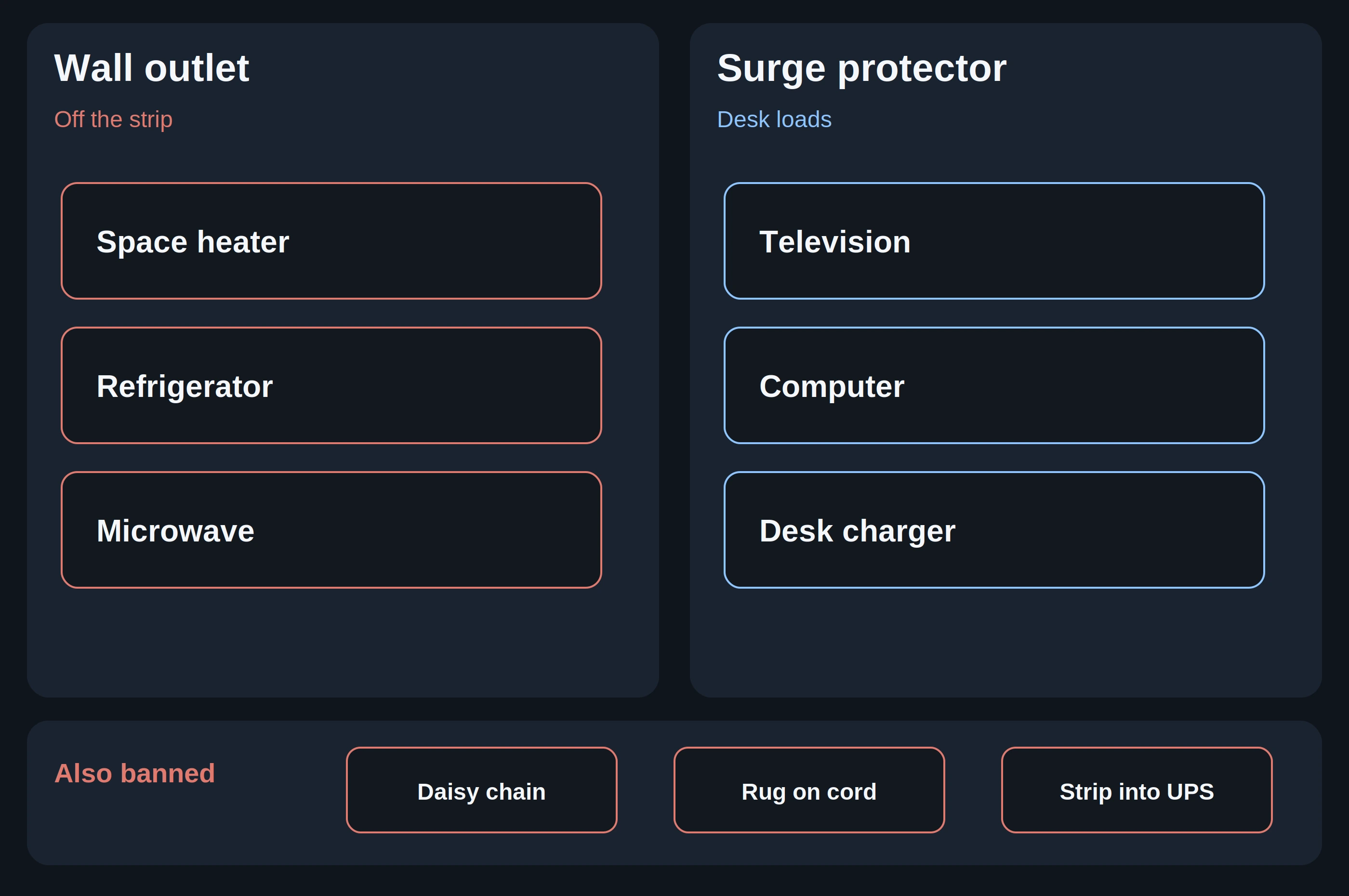
The heater, the refrigerator, and the microwave go to a wall outlet. OSHA says a strip is designed for computers, peripherals, and audio or video equipment.
When is the wall outlet the right receptacle?
A power strip or a surge suppressor does not add capacity to the branch circuit. It only adds places to plug in. Listed or labeled equipment has to be installed and used the way the listing says. A listed relocatable power tap connects to a permanently installed receptacle. It is not series-connected to another tap or to an extension cord.
Flexible cords and cables may not replace the fixed wiring of a structure. They may not run through holes in walls, ceilings, or floors. They may not run through doorways, windows, or similar openings. They may not be concealed behind building walls, ceilings, or floors.
The UL Solutions guide says never throw a rug over a long cord. People walking on the cord can break the wires, the wires can heat, and that heating can become a smoldering fire.
Daisy-chaining MOV strips does not spread the surge evenly. The parts sit in parallel, and the surge typically goes through the one that triggers first. That series connection is against most codes whether or not the strips contain MOVs. Do not plug a surge strip into a UPS. While the MOV is conducting, the UPS sees an overload. Use the surge protection built into the UPS.
Should a TV use a surge protector?
A computer or a television does not draw a tremendous amount of power. OSHA already names computers and audio or video equipment as the loads a strip is designed for. The UL Solutions guide says a surge protector matters in a place with electrical storms, in a rural supply, or in a building whose large motors, such as a furnace or an elevator, send spikes down the line. The reason is the clamp. The wall outlet remains a normal receptacle for the television. The wall outlet does not perform that clamp.
Pick the wall charger in the GaN charger guide. Match the USB-C port and the cable in the PDP mismatch guide. Those two pages own the charger and the cord. They do not choose the outlet bar.
How do a cord, a strip, and a protector differ?
An extension cord is a flexible cable with a plug on one end and one or more sockets on the other. In the United States, UL certifies extension cords to UL 817 for the entire extension cord and UL 62 for the cable. Those are cord standards. They are not the surge standard.
A power strip is the block of sockets, usually three or more, on the end of that cable. The same name is used for the whole short cord that ends in the block.
UL 1363 covers an indoor cord-and-plug relocatable power tap rated 250 V AC or less and 20 amperes or less. In line with the National Electrical Code, NFPA 70, that tap is a movable supply for cord-and-plug equipment. It does not serve as the fixed wiring of a structure or of fixed furnishings, such as a permanent counter.
A cord-and-plug product with fewer than three outlets that includes a surge protective device is covered under UL 1449 for Type 3. A relocatable power tap with more than two outlets and a surge protective device also has to meet the cord-connected Type 3 requirements in UL 1449. A battery-backup feature in the primary circuit is a UPS under UL 1778. It is not a feature of the relocatable power tap.
How does a surge protector compare with a power conditioner?
A power conditioner is a device meant to improve the quality of the power delivered to the load. It smooths the AC sine wave and holds the voltage while the load changes. An AC conditioner commonly includes surge protection and noise filtering as well. That extra clamp does not make a surge strip a power conditioner.
A swell is an RMS voltage 10 to 80 percent above nominal for 0.5 cycle to 1 minute. A sag is an RMS voltage 10 to 90 percent below nominal for that same window. A spike is the abrupt, very brief rise, from a large inductive load turning off or from lightning. Undervoltage is a drop below 90 percent of nominal that lasts more than 1 minute. Overvoltage is a rise above 110 percent of nominal that lasts more than 1 minute.
NEMA treats a transient and a surge as the same short event. The duration is usually greater than 10 microseconds and less than 1 millisecond, and the peak can exceed 10 kA or 10 kV. A temporary overvoltage lasts seconds to minutes. An SPD is not designed to protect downstream equipment from a temporary overvoltage. ANSI/UL 1449 ensures the device will not create a safety hazard during one.
When do you replace the strip?
Each time a MOV shorts, its threshold voltage is reduced slightly. After enough events the part can look intact while it no longer clamps as it did. Wikipedia treats a 10 percent change in clamping voltage as functional degradation. That 10 percent mark is on the varistor page. It is not a UL pass-fail line. A MOV can also fail open, leave the load powered, and a user may have no indication that the surge protection is gone. NEMA says a failed suppression part most often fails as a short.
A thermal fuse can disconnect a MOV that has overheated and leave the outlets working without surge protection. A lamp may show whether those MOVs are still in the circuit. That lamp is separate from the neon or LED that only reports power.
Power strips and surge protectors do not expire on a calendar. The UL Solutions guide says to inspect the cord and the housing and to discard the strip when the cord is frayed or the insulation is brittle. A large surge, such as lightning, is a separate case. ESFI says the suppressor is then likely a one-time-use protector and will likely need replacement.
Wikipedia, reporting IEEE and ANSI assumptions for surges inside a building other than lightning, gives an envelope of up to 6,000 volts, 3,000 amperes, and 90 joules. The lightning figures on that page are test assumptions: typically 10,000 amperes (10 kA) inside the building, from a 20 kA strike splitting both ways, and up to 200 kA on the line with 100 kA each way, attributed to ANSI/IEEE C62.41 and UL 1449 3rd edition. Those figures are not a duty for a household Type 3 strip, and they are not a requirement that a plug-in strip carry 10 kA.
Wikipedia attributes the UL 1449 edition years to the National Fire Protection Association: a 1986 edition, then revisions in 1998, 2009, and 2015, with fire as the concern. That chronology is Wikipedia’s sentence.
Desk and appliance outlet checklist
- Space heater: CPSC Publication 098 says never use an extension cord or a power strip. ESFI says plug the heater into an outlet and skip the extension cord.
- Refrigerator and microwave: OSHA says a strip is not designed for either appliance. Use a wall outlet.
- Television and computer: the surge protector is there for the clamp. The wall outlet still suits the load.
- Desk charger: use the charging guides linked above for the charger and the cable. This checklist only places the outlet bar.
- Series connection: the tap plugs into a permanently installed receptacle. It does not feed another tap, an extension cord, or a UPS.
- Cord routing: no rug over the cord, and no run through a wall, a doorway, or a concealed space.
- Label: read Type, VPR, MCOV, and In. Leave joules out of the ranking.
- After lightning, treat the suppressor as likely one-time use. On an ordinary day, replace a strip whose cord or housing is damaged. There is no calendar expiry.
Sources
- Wikipedia: Surge protector
- Wikipedia: Power strip
- Wikipedia: Varistor
- Wikipedia: Power conditioner
- Wikipedia: Extension cord
- OSHA interpretation on relocatable power taps, November 18, 2002
- OSHA 29 CFR 1910.303
- OSHA 29 CFR 1910.304
- OSHA 29 CFR 1910.305
- CPSC Publication 098, portable electric heaters
- NIST significance preface, 1989 Zurich symposium
UL Solutions, the UL 1363 catalog scope, NEMA’s surge pages, and the ESFI indoor booklet are named above and are not linked here.
Related articles
Power Bank Safety, Cutoffs & Battery Swelling
How power bank BMS protection cutoffs, thermal throttling, and battery outgassing work—plus warning signs of swelling and safe lithium-ion disposal rules.
Read article
100W USB-C Charger: PDO Match Between Charger, Cable and Laptop
A Port Present PDP greater than 60W requires a 5A cable. Match charger PDO profiles, cable eMarker identity, multi-port sharing rules and laptop or power bank charging speed.
Read article
TSA Power Bank Rules: Watt-Hours from Milliamp-Hours
Power banks must be carried on and cannot be checked. Learn how to check battery capacity, calculate watt-hours and prepare your flight packing checklist.
Read article