
Do Power Banks Go Bad If Not Used? Storage Checks
Found a power bank after months unused? Separate charge loss from aging, check its condition, and keep a model-specific storage and recheck record.
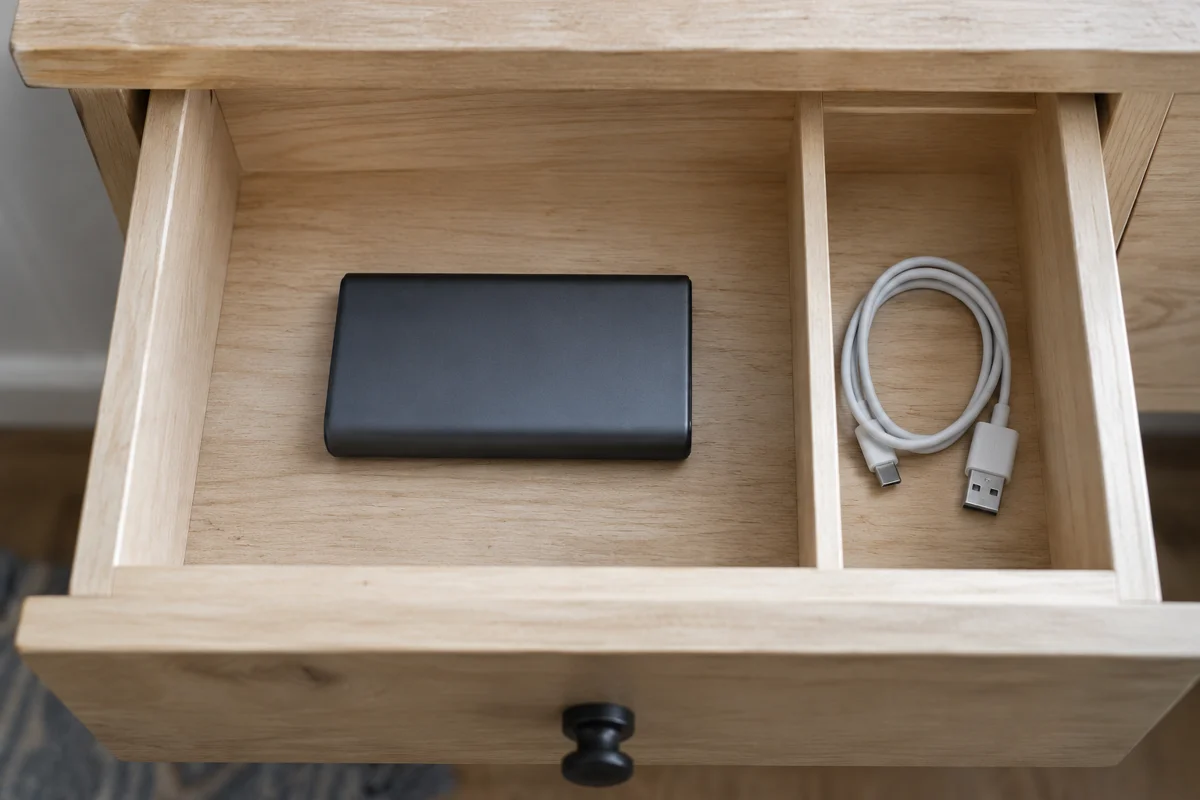
A forgotten power bank may leave you without backup power when you need it. Yes, a power bank can deteriorate while unused, but a lower charge reading after storage does not by itself mean the battery has failed. Check the exact model’s instructions and its condition before charging it; an unresponsive unit needs manufacturer guidance rather than a forced revival attempt.
This guide is for someone retrieving a portable USB power bank after months in storage or putting one away for later. It provides a storage record and a return-to-use checklist compiled from public manufacturer and US authority guidance checked on October 15, 2026. It does not diagnose the cells inside your unit or guarantee a remaining lifespan. If you are choosing a replacement, use the separate power-bank selection guide.
Separate remaining charge from battery aging
There are different questions behind “Has it gone bad?”:
Scroll horizontally to see all columns.
| Question | What to look for | What it cannot establish |
|---|---|---|
| Has stored charge fallen? | The unit’s indicated charge compared with your previous dated reading | The remaining capacity or internal condition |
| Has useful capacity declined? | A change in ordinary charging performance under comparable conditions | A precise health percentage from indicator lights |
| Is there a reason to stop using it? | Physical changes, abnormal behavior, or a manufacturer warning affecting the unit | A safe-use guarantee just because the exterior looks normal |
Anker’s charge-retention explanation describes self-discharge and the small draw of internal circuitry while idle. We do not apply its suggested monthly loss percentage to your bank. The actual decline needs observations of that unit under recorded conditions.
Capacity loss is a different issue. Apple’s battery-aging explanation distinguishes chemical age from elapsed time and describes declining capacity as lithium-ion cells age. Its iPhone-specific settings and cycle targets do not apply to a power bank. The practical distinction is that recharging adds stored energy; a full indicator is not evidence that the battery retains its original capacity.
Consequently, “unused” is not a preservation guarantee, and “several months old” is not a diagnosis. A published cycle estimate also cannot tell you how many years an unknown bank will last in a drawer. Keep the model, storage history and current observations together instead of assigning a universal expiry date.
Start with the model and its own storage instructions
Find the model identifier on the unit and open its official manual or support page. Save the document title, URL and date you checked it. A brand name alone is not enough to establish that guidance for another model applies.
Copy the storage charge level, storage environment, maintenance interval and normal charging instructions into your record. Keep storage and charging temperature limits in separate fields. Permission to store a battery at a temperature does not establish permission to charge it there.
Even pages from one manufacturer can differ. These are examples from the Anker documents opened for this guide, not instructions for every power bank:
Scroll horizontally to see all columns.
| Official document | What that document says | How to use the information |
|---|---|---|
| UK Power Bank Safety Guide | Approximately 60% charge for long storage; recharge every 3 months; operating/storage range 0–35°C | Brand-level guidance; confirm its application to your model |
| Extended-storage support answer | Discharge and recharge at least every 3–4 months | Do not interpret this as permission to force an empty or damaged unit through a cycle |
| EU lifespan and temperature FAQ | Recharge at least every 3 months; gives -10–35°C for 3-month storage | That storage range is not a charging range |
Do not combine the lowest temperature from one page, the longest interval from another and a charge target from a third into a new rule. Our recommendation is to start with the exact model’s current manual and ask its manufacturer to resolve conflicting guidance. Leave a missing requirement blank or write Unknown / verify on the unit until you have an applicable answer.
Put it away with a dated check record
For an intact unit being stored normally, follow its documented charge target and maintenance procedure. Anker’s safety guide calls for dry ports, protection from moisture and physical damage, and separation from keys and metal objects. It also advises against draining the battery completely. Do not improvise repeated deep-discharge cycles as a storage treatment.
Choose a location you can identify in your record. The US Fire Administration’s battery guidance advises room-temperature storage where possible, away from combustible materials, direct sun and hot cars. A drawer is not automatically suitable: its contents and surroundings still matter.
Set the next reminder from the requirement you actually copied. For example, if the instructions applicable to your unit specify a three-month interval, a maintenance check completed on October 15, 2026 gives a next date of January 15, 2027. This is a calendar example, not a recommendation that every bank can be ignored for three months. Record a different date when your manual requires it.
Keep a separate planned-use reminder if you need the bank for a particular trip. Our recommendation is to leave time to check ordinary operation before depending on it, rather than discovering a problem while leaving home. The wider Charging & Power guides cover device and charging-interface questions separately.
Inspect it before reconnecting anything
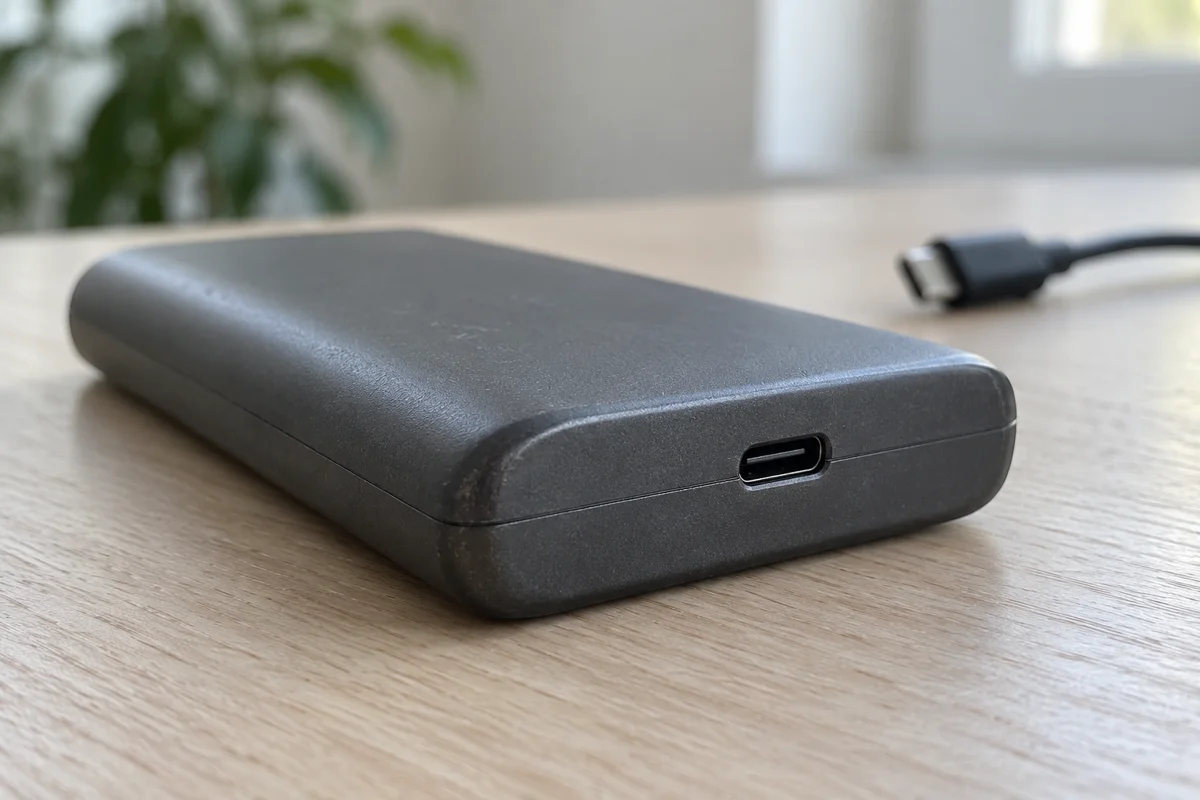
Bring the bank to a well-lit place and inspect the enclosure and ports without opening it. Use this checklist as a record of observations, not a certification of internal safety:
- Identify the model and check its manufacturer’s current safety or recall notices. An affected unit follows the notice’s instructions.
- Look for swelling or a changed shape, a separated seam, cracks, discoloration or leakage. Note any known crushing, impact or liquid exposure.
- Look at the ports for visible damage or moisture. Do not use a connection that you cannot assess confidently.
- Note any unusual smell, excessive heat or odd noises. Do not plug it in merely to see whether those signs disappear.
The US Fire Administration lists changes in shape or color, odor, leaks, excessive heat and unusual noises as reasons to stop using a lithium-ion battery. Anker’s guide says to stop if liquid enters the product and to avoid disassembly. An ordinary-looking case cannot rule out an internal problem; uncertainty belongs in the contact-manufacturer branch below.
Decide whether to proceed or contact the manufacturer
Follow the first applicable row. These are editorial decision prompts based on the sources above, not a repair procedure or a battery-health test.
Scroll horizontally to see all columns.
| What you find | Next action |
|---|---|
| A recall or safety notice applies | Stop and follow that notice, including its handling instructions |
| Damage, liquid ingress or a warning sign from the checklist | Stop using or charging; obtain manufacturer handling guidance |
| Model, charging instructions or storage history raises an unresolved concern | Ask the manufacturer before attempting to charge |
| No concerns identified and applicable instructions are available | Follow the unit’s normal documented charging procedure while observing it |
| It remains unresponsive or behaves abnormally during that procedure | Stop the attempt and contact support; do not open, bypass or force-charge it |
| It charges and works normally with your intended device | Record the observation and next check; normal operation does not certify remaining lifespan |
A dark display or unlit indicator does not reveal why the bank is unresponsive. This guide deliberately provides no jump-start, direct-cell charging, heating or disassembly instructions. Give support the model identifier, time unused, storage conditions you know and what happened during the permitted normal procedure. Write “unknown” for history you cannot reconstruct.
Observe normal charging and ordinary use
Use the charger, cable and input connection permitted by the manual. Anker’s safety guide calls for compatible accessories, an uncovered device and a cool, dry, ventilated charging area; avoid beds and sofas and disconnect when fully charged. For this first check, our recommendation is to remain available to observe the unit instead of leaving an unknown bank charging overnight.
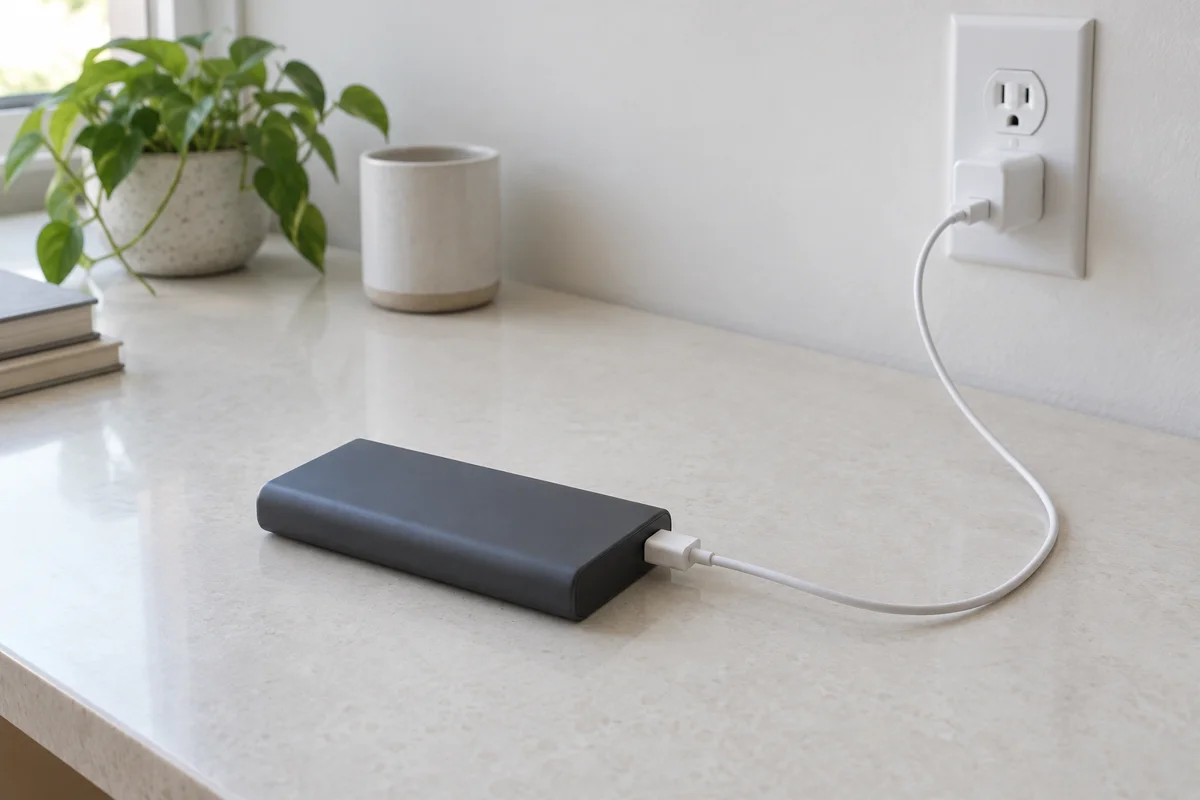
If normal charging completes without a concern, try your intended device using a compatible connection and note what happens. Compare with your own earlier observations only when the device, cable and use conditions are similar. A phone’s displayed percentage change is not a measurement of the bank’s original capacity. Do not run repeated empty-to-full cycles to prove that a questionable unit is healthy.
Save this storage and return-to-use record
Copy this into a note and keep one record per bank. The requirement fields describe what the manufacturer says; the observation fields describe what you actually saw. Do not fill either with an assumed specification.
Brand / exact model:
Official manual or support URL / document version:
Guidance checked on:
Storage charge target / source section:
Storage temperature limits / source section:
Charging temperature limits / source section:
Maintenance procedure and interval / source section:
Storage location / known exposure history:
Date put away / indicated charge:
Last inspection or maintenance date / action completed:
Next check date / basis in applicable instructions:
Recall or safety-notice check / date:
Exterior and port observations:
Normal charging observations / date:
Intended-device operation / conditions / date:
Decision: normal use / contact manufacturer / disposal guidance
Unresolved questions / manufacturer's response:
An observation such as “indicator lit; phone accepted charging” records that event only. It does not establish a health percentage, remaining cycle count or permission to use a different charger. Update the next-check field after completing the applicable maintenance action, and retain unresolved concerns until the manufacturer answers them.
If the unit needs disposal
For US households, the EPA’s lithium-ion battery guidance directs batteries and devices containing them to appropriate collection services, rather than household trash or municipal recycling bins. For a damaged unit, ask the manufacturer for specific handling instructions and confirm that the receiving program accepts it before arranging a drop-off. Do not dismantle a sealed power bank to extract its cells.
Sources and method
This is a public-source checklist, with no hands-on battery testing. Sources were opened and checked on October 15, 2026: Anker’s linked storage, temperature, safety and charge-retention pages; Apple’s battery-aging explanation; the US Fire Administration’s Battery Fire Safety page; and EPA’s Used Lithium-Ion Batteries guidance. The model record and decision table are our organization of those sources. Anker examples retain their document-specific scope; no generic monthly discharge rate, calendar lifespan or guarantee of safe recovery is assigned to your unit.
Related articles
Camping Power Banks: Capacity, Weight and Solar
Plan a camping charging kit from daily energy use, carried weight and realistic solar conditions, with a worked Wh budget and pre-trip checks.
Read article
How to Tell a USB-C Plug from USB-A, Micro-USB, and Lightning
Match the plug to the port before you blame the charger. USB-C and USB Type-C are the names USB-IF uses. Power and data marks are a separate check.
Read article
How to Choose a USB-C Car Charger for a Phone or Laptop
Check your car's accessory-socket limit, the charger's input range, each USB-C port's PDO and PPS output, the shared-port split and the cable before you buy.
Read article